Render on a key color
ClipBrook cuts out art that was generated on a solid background color. It does not work on photographs. A photo has no key color to remove.
This page is about the step before the cut: what to put in your prompt so the background arrives flat enough to cut. That flat background is called the key color, and three of them work: pure blue (#0000FF), pure red (#FF0000) and pure green (#00FF00).
Paste this on the end of your prompt
Write your prompt for the subject the way you always do. Then pick a key color below, tick anything your subject really contains, and paste the whole block after your own words. The block describes the background and the lighting, not what you are drawing, so it goes on the end of any prompt unchanged. The optional lines you tick do mention parts — leaves, berries, stems, needles — because that is the hazard they are there to prevent.
Isolated on a completely flat, uniform, solid pure blue (#0000FF) digital chroma-key background. The pure blue background fills the image edge to edge like a flat digital chroma-key screen with no gradient, staying at full brightness inside every gap and opening in the subject; no reflection or tint of pure blue on the subject. Every edge of the subject is crisp, sharp and hard against the pure blue, with no soft, blurry, feathered or glowing transitions, no depth-of-field blur, no haze or halo; inside every hole and gap the pure blue stays at full brightness right up to the edge. Shaded parts of the subject keep their own natural color, never a pure blue tint. Everything in sharp focus with deep depth of field, evenly lit with soft neutral studio light, no cast shadow, no contact shadow, no ambient occlusion, no bounce light. The entire subject is centered and completely inside the frame with at least 10% empty background margin on every side, nothing cropped or touching the image edges. No frame, no border, no paper, no mockup, no vignette, no text, no watermark, no deformed or duplicated parts. No floating or detached fragments, no stray specks, dust or debris anywhere on the background; every element is physically attached to the subject.
Pick the key color
The rules, in the order they apply.
- The subject is blue or purple — lavender, violet, navy, teal, that whole family. Use red for blue or purple subjects.
- The subject has leaves, stems or petals. Use blue for plants and foliage. Green is the wrong key for anything with leaves or plants. Their own green gets removed with the background.
- The subject is blue and red at once, a blue-and-orange racing car say, with no plants in it. Green is the only key left.
- Anything else. Blue, the default.
Every pick has a second choice behind it. If red runs into the subject, blue is the fallback, and the other way around. You will reach for it: a purple wreath can arrive carrying rust-red berries the prompt never mentioned.
You do not have to work the rules by hand. The key-color advisor takes a plain description of your subject, names the key and the fallback, shows which words decided it, and writes the whole prompt.
Sitting on a batch already rendered on green? Removing a green screen covers cutting those, and which of them are worth rendering again on blue.
Why not white
White is what the stock sites show, so it is the obvious thing to ask for, and it is the one background a cut cannot tell apart from the subject. White lives inside most subjects: highlights, teeth, paper, snow, the pale tip of a petal. Color alone does not separate subject-white from background-white, so the edge comes back with gray fringes and chewed detail.
Pure blue avoids all of that, because #0000FF almost never occurs inside a real subject. The cut measures the background from the outer border of the image, then works out how much of each edge pixel was background and takes exactly that much away: a pixel that is 40 percent background becomes 40 percent transparent, at whatever resolution you rendered. Glass, thin petals and watercolor washes come out genuinely semi-transparent instead of either solid or gone.
There is a duller reason as well. Generators rarely render “white background” as real #FFFFFF; what arrives is ivory, or lit paper, or corners that darken. “A completely flat, uniform, solid pure blue (#0000FF) digital chroma-key background” leaves far less room for interpretation, and most current models honor the hex code.
What the block says, sentence by sentence
Asking for a flat background is not enough on its own, because image models light a backdrop like a photo studio instead of filling it like a paint bucket. Each sentence below switches one of those habits off. On the blue key it reads:
The pure blue background fills the image edge to edge like a flat digital chroma-key screen with no gradient, staying at full brightness inside every gap and opening in the subject; no reflection or tint of pure blue on the subject. Every edge of the subject is crisp, sharp and hard against the pure blue, with no soft, blurry, feathered or glowing transitions, no depth-of-field blur, no haze or halo; inside every hole and gap the pure blue stays at full brightness right up to the edge. Shaded parts of the subject keep their own natural color, never a pure blue tint.
“Fills the image edge to edge … with no gradient.” Left alone, a model paints the backdrop brighter in the middle and lets it fall away toward the corners. The cut measures one background color, so corners that are a different blue from the center survive it as blue haze.
“Staying at full brightness inside every gap.” Renderers darken enclosed spaces, the hole in a wreath or the slivers between leaves, the way a real cavity gets less light. Darker blue in the gap is a different blue, and the cut leaves gray-blue fog sitting in every opening. When ClipBrook’s badge says foggy gaps cleaned up, that fog is what it cleaned up.
“No reflection or tint of blue on the subject.” Anything standing in front of a big blue screen catches blue bounce light, and models copy that faithfully. Blue on the subject reads as background, and the rim of your subject goes with it.
“No soft, blurry, feathered or glowing transitions, no depth-of-field blur.” A cuttable edge mixes from subject to background across a pixel or two. Depth of field smears that boundary over ten or twenty pixels, and the whole band comes back half-transparent. A soft outer glow, the sticker look, does the same and leaves a luminous ring behind.
“Shaded parts of the subject keep their own natural color.” Without it, shadows on the subject drift toward the background color, and whatever matches the background gets removed. Dark green leaves on a blue render are the usual casualty.
Framing
The block ends by asking for the subject centered, whole, with at least 10 percent empty margin on every side and nothing touching the edges. That margin is not cosmetic: the cut measures the background from the border of the image, and a leaf crossing the border spoils the measurement. The same sentences ban frames, borders, paper and mockups, because models like to stand clipart on a little stage, and they ban stray specks and detached fragments, because a scatter of floating petals either survives the cut as junk or fails the quality check. When a badge says the subject touches the edge, these are the sentences to check.
The optional sentences
Each box in the block adds one sentence, and each of those sentences exists because a render failed. Tick one only when the thing is really in your subject, since every extra sentence takes room away from the description of the subject itself.
- Snow lying on the subject
Translucent snow lets the background color through it, and whatever reads as background is exactly what the cut takes away, so the snow goes with it. Falling flakes fail a second way: each flake is a piece of its own, and a separate piece smaller than about 28 by 28 pixels on a 4K render is dropped.
the snow is opaque solid white sitting on the surfaces with crisp defined edges, dry and powdery, not translucent, no glittering sparkle particles, no falling snow, no mist or haze- Frost or ice crystals
A haze of frost comes out only a few percent solid, and anything under 8 percent is taken all the way to transparent. A dusting rendered that way comes back eaten away in patches instead of holding its shape.
the frost is opaque crisp white crystals clinging to the surface with hard defined edges, not a translucent haze, no glitter particles, no mist- Candles or flames
A flame washes the key color out of the background around itself, and washed-out key color is no longer strong enough to count as background. The glow survives the cut as a bright ring sitting where the candle was.
the candles are completely unlit with clean unburned wicks, no flame, no fire, no glow, no halo and no light spilling onto the greenery- Gold or metal
A mirror finish reflects the screen, which puts key color deep inside the subject. Spill cleanup only reaches about 12 pixels in from the outline, so it never gets that far; what happens instead is that the quality check counts those pixels and tells you to render again on the other key.
the gold elements are matte brushed metal with a soft satin finish, no mirror reflections, no specular glints and nothing reflecting the background colour- Dried orange slices
A backlit slice lets the screen shine through it, so the flesh takes on the background color and gets cut away with the background. This is the render that comes back with the quality badge reading key color inside the subject.
the dried orange slices are opaque with solid amber flesh and a crisp defined rim, not translucent and not backlit- Cotton bolls
A wispy fiber edge leaves nothing solid to measure against. With no confident subject color anywhere near it, the edge falls back to a rough estimate, and the faintest parts of that estimate then go to fully transparent, which is why the fringe comes back thin and uneven.
the cotton bolls are opaque soft white with clearly defined outlines, not wispy or fibrous at the edge- White or glassy berries
A glassy berry works as a lens and shows the background through itself. Background color is removed wherever it turns up, so the berry comes out with holes in it.
the berries are opaque solid matte white spheres, not translucent or glassy- Ribbon or satin
A satin sheen picks the key color up across the middle of the ribbon, further from the outline than the 12 pixels spill cleanup reaches. A bright enough highlight stops looking like subject at all and is cut away as background.
the ribbon is matte woven fabric with crisp folded edges and no sheen or reflection- Line art
There is a rescue pass that keeps antennae and wire-thin stems, and only near-black strokes qualify for it: the brightest of the three channels has to stay under 55 out of 255. A gray wash is too light for that and too mixed with the background to pass as subject, so it comes out semi-transparent.
solid pure black lines of uniform thin stroke weight, fully opaque with hard clean edges, no grey wash, no gradient, no shading and no sketchy double strokes- Conifer needles
Ask for thicker blades, not for wider gaps between them. A needle 5 to 8 pixels wide on a 4K render is 30 to 50 percent edge, so there is no clean interior left to hold on to. Across the batch this guide is built from, broad-leaved subjects cut cleanly and fine fir mats came out ragged; the one exception was a frosted pine whose needles were thicker.
the needles are short, broad and thick like a nordmann fir, each one a flat solid opaque blade with a blunt rounded tip, never fine, hair-thin, wispy or feathery- Fine or narrow leaves
The same geometry as conifer needles, for foliage that is not a conifer. A leaf thinner than a few pixels is edge all the way through, which leaves the spill cleanup no untinted interior to take its reference color from.
the leaves are short thick flat blades with blunt rounded tips, solid and opaque, never fine, hair-thin or wispy- Loose or scattered arrangement
A detached piece becomes an island of its own, and an island smaller than about 28 by 28 pixels on a 4K render is deleted. The framing sentences already ban floating fragments, but two renders grew stray leaves regardless, because a model can draw whatever a negation names. Saying it positively works better, and this is deliberately the one instruction the block states twice.
the whole design is one single connected piece and every leaf, berry and stem grows physically out of it, with the background around it completely empty and nothing at all drawn anywhere else in the frame
Prompts as they were actually sent
Quoted word for word, from a batch sent to Gemini 3.1 Flash Image at 4K on 2026-08-20. The cut-outs are published on Adobe Stock. They carry an older wording of the same block, so they do not line up with it sentence for sentence.
christmas card border with pine and berries

The render, and the cut ClipBrook makes from it. christmas card border of short broad-needled pine sprigs and red berries, narrow upright rectangular card border, neat and evenly balanced on all sides, empty center with copy space, the needles are short, broad and thick like a nordmann fir, each one a flat solid opaque blade with a blunt rounded tip, never fine, hair-thin, wispy or feathery, photorealistic, highly detailed, clean high-key studio light, isolated on a completely flat, uniform, solid pure blue (#0000FF) digital chroma-key background, everything in sharp focus with deep depth of field, no bokeh or background blur, evenly lit with soft neutral studio light, no cast shadow, no contact shadow, no ambient occlusion, no bounce light, the background stays uniformly bright inside every gap between leaves, petals and stems, no text. The pure blue background fills the image edge to edge like a flat digital chroma-key screen with no gradient, staying the same bright pure blue inside every gap; no reflection or tint of pure blue on the subject. Every leaf, petal and stem has a crisp, sharp, hard edge against the pure blue - no soft, blurry, feathered or glowing transitions, no depth-of-field blur, no haze or halo; inside every hole and gap between the leaves the pure blue is at full brightness right up to the edge of the leaf. Shaded parts of the subject keep their own natural colour (dark green, brown), never a pure blue or violet tint. The entire subject is centred and completely inside the frame with at least 10% empty background margin on every side, nothing cropped or touching the image edges. No frame, no border, no paper, no mockup, no vignette, no text, no watermark, botanically correct, no deformed or duplicated parts. No floating or detached fragments, no stray specks, dust or debris anywhere on the background; every element is physically attached to the arrangement.
juniper branch with berries
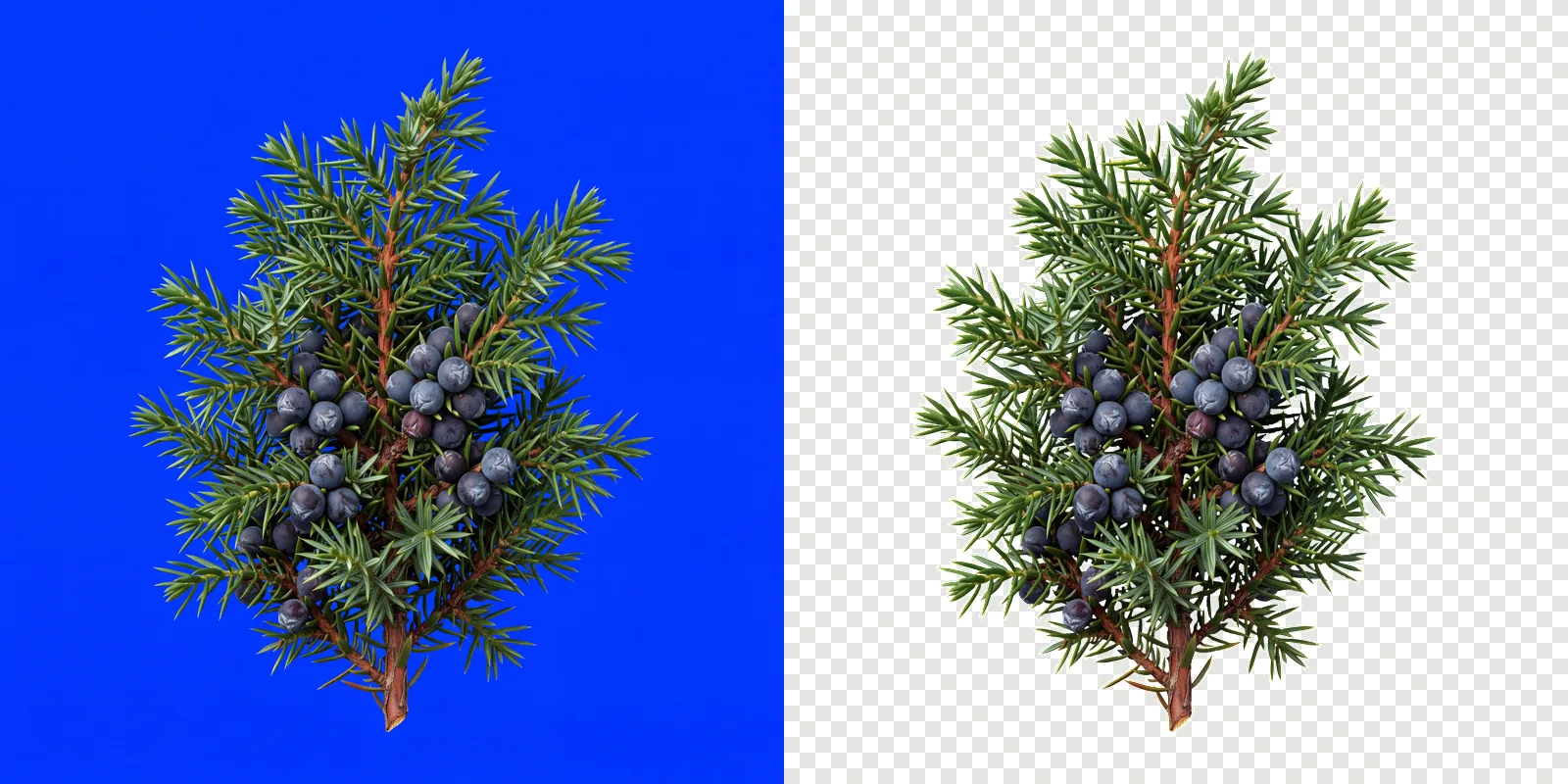
The render, and the cut ClipBrook makes from it. juniper branch with ripe berries among the needles, short dense sprig standing upright with the berries visible between the needles, photorealistic, highly detailed, bright neutral daylight, isolated on a completely flat, uniform, solid pure blue (#0000FF) digital chroma-key background, everything in sharp focus with deep depth of field, no bokeh or background blur, evenly lit with soft neutral studio light, no cast shadow, no contact shadow, no ambient occlusion, no bounce light, the background stays uniformly bright inside every gap between leaves, petals and stems, no text. The pure blue background fills the image edge to edge like a flat digital chroma-key screen with no gradient, staying the same bright pure blue inside every gap; no reflection or tint of pure blue on the subject. Every leaf, petal and stem has a crisp, sharp, hard edge against the pure blue - no soft, blurry, feathered or glowing transitions, no depth-of-field blur, no haze or halo; inside every hole and gap between the leaves the pure blue is at full brightness right up to the edge of the leaf. Shaded parts of the subject keep their own natural colour (dark green, brown), never a pure blue or violet tint. The entire subject is centred and completely inside the frame with at least 10% empty background margin on every side, nothing cropped or touching the image edges. No frame, no border, no paper, no mockup, no vignette, no text, no watermark, botanically correct, no deformed or duplicated parts. No floating or detached fragments, no stray specks, dust or debris anywhere on the background; every element is physically attached to the arrangement.
advent wreath with candles
advent wreath of broad glossy magnolia and bay laurel leaves with four unlit cream pillar candles standing evenly around the ring, full lush ring seen from a slightly raised three-quarter angle, empty center with copy space, the candles are completely unlit with clean unburned wicks, no flame, no fire, no glow, no halo and no light spilling onto the greenery, photorealistic, highly detailed, soft diffused studio lighting, isolated on a completely flat, uniform, solid pure blue (#0000FF) digital chroma-key background, everything in sharp focus with deep depth of field, no bokeh or background blur, evenly lit with soft neutral studio light, no cast shadow, no contact shadow, no ambient occlusion, no bounce light, the background stays uniformly bright inside every gap between leaves, petals and stems, no text. The pure blue background fills the image edge to edge like a flat digital chroma-key screen with no gradient, staying the same bright pure blue inside every gap; no reflection or tint of pure blue on the subject. Every leaf, petal and stem has a crisp, sharp, hard edge against the pure blue - no soft, blurry, feathered or glowing transitions, no depth-of-field blur, no haze or halo; inside every hole and gap between the leaves the pure blue is at full brightness right up to the edge of the leaf. Shaded parts of the subject keep their own natural colour (dark green, brown), never a pure blue or violet tint. The entire subject is centred and completely inside the frame with at least 10% empty background margin on every side, nothing cropped or touching the image edges. No frame, no border, no paper, no mockup, no vignette, no text, no watermark, botanically correct, no deformed or duplicated parts. No floating or detached fragments, no stray specks, dust or debris anywhere on the background; every element is physically attached to the arrangement.
snowy pine branch
snowy pine branch, short branch seen from directly above with the snow lying evenly across the needles, the snow is opaque solid white sitting on the surfaces with crisp defined edges, dry and powdery, not translucent, no glittering sparkle particles, no falling snow, no mist or haze, the needles are short, broad and thick like a nordmann fir, each one a flat solid opaque blade with a blunt rounded tip, never fine, hair-thin, wispy or feathery, photorealistic, highly detailed, even flat light, isolated on a completely flat, uniform, solid pure blue (#0000FF) digital chroma-key background, everything in sharp focus with deep depth of field, no bokeh or background blur, evenly lit with soft neutral studio light, no cast shadow, no contact shadow, no ambient occlusion, no bounce light, the background stays uniformly bright inside every gap between leaves, petals and stems, no text. The pure blue background fills the image edge to edge like a flat digital chroma-key screen with no gradient, staying the same bright pure blue inside every gap; no reflection or tint of pure blue on the subject. Every leaf, petal and stem has a crisp, sharp, hard edge against the pure blue - no soft, blurry, feathered or glowing transitions, no depth-of-field blur, no haze or halo; inside every hole and gap between the leaves the pure blue is at full brightness right up to the edge of the leaf. Shaded parts of the subject keep their own natural colour (dark green, brown), never a pure blue or violet tint. The entire subject is centred and completely inside the frame with at least 10% empty background margin on every side, nothing cropped or touching the image edges. No frame, no border, no paper, no mockup, no vignette, no text, no watermark, botanically correct, no deformed or duplicated parts. No floating or detached fragments, no stray specks, dust or debris anywhere on the background; every element is physically attached to the arrangement.
new year gold and white floral arrangement
new year arrangement of white roses with matte brushed gold painted leaves, wide fan-shaped arrangement opening symmetrically from a narrow base, the gold elements are matte brushed metal with a soft satin finish, no mirror reflections, no specular glints and nothing reflecting the background colour, photorealistic, highly detailed, soft diffused studio lighting, isolated on a completely flat, uniform, solid pure blue (#0000FF) digital chroma-key background, everything in sharp focus with deep depth of field, no bokeh or background blur, evenly lit with soft neutral studio light, no cast shadow, no contact shadow, no ambient occlusion, no bounce light, the background stays uniformly bright inside every gap between leaves, petals and stems, no text. The pure blue background fills the image edge to edge like a flat digital chroma-key screen with no gradient, staying the same bright pure blue inside every gap; no reflection or tint of pure blue on the subject. Every leaf, petal and stem has a crisp, sharp, hard edge against the pure blue - no soft, blurry, feathered or glowing transitions, no depth-of-field blur, no haze or halo; inside every hole and gap between the leaves the pure blue is at full brightness right up to the edge of the leaf. Shaded parts of the subject keep their own natural colour (dark green, brown), never a pure blue or violet tint. The entire subject is centred and completely inside the frame with at least 10% empty background margin on every side, nothing cropped or touching the image edges. No frame, no border, no paper, no mockup, no vignette, no text, no watermark, botanically correct, no deformed or duplicated parts. No floating or detached fragments, no stray specks, dust or debris anywhere on the background; every element is physically attached to the arrangement.
cinnamon and star anise christmas arrangement
christmas spice arrangement of cinnamon stick bundles, whole star anise, dried orange slices and broad bay laurel leaves tied with natural twine, compact spice bundle laid diagonally across the frame, the cinnamon sticks banded together at the middle with the star anise and orange slices tucked around the band, the dried orange slices are opaque with solid amber flesh and a crisp defined rim, not translucent and not backlit, photorealistic, highly detailed, gentle directional side light, isolated on a completely flat, uniform, solid pure blue (#0000FF) digital chroma-key background, everything in sharp focus with deep depth of field, no bokeh or background blur, evenly lit with soft neutral studio light, no cast shadow, no contact shadow, no ambient occlusion, no bounce light, the background stays uniformly bright inside every gap between leaves, petals and stems, no text. The pure blue background fills the image edge to edge like a flat digital chroma-key screen with no gradient, staying the same bright pure blue inside every gap; no reflection or tint of pure blue on the subject. Every leaf, petal and stem has a crisp, sharp, hard edge against the pure blue - no soft, blurry, feathered or glowing transitions, no depth-of-field blur, no haze or halo; inside every hole and gap between the leaves the pure blue is at full brightness right up to the edge of the leaf. Shaded parts of the subject keep their own natural colour (dark green, brown), never a pure blue or violet tint. The entire subject is centred and completely inside the frame with at least 10% empty background margin on every side, nothing cropped or touching the image edges. No frame, no border, no paper, no mockup, no vignette, no text, no watermark, botanically correct, no deformed or duplicated parts. No floating or detached fragments, no stray specks, dust or debris anywhere on the background; every element is physically attached to the arrangement.
nordic christmas arrangement with cotton
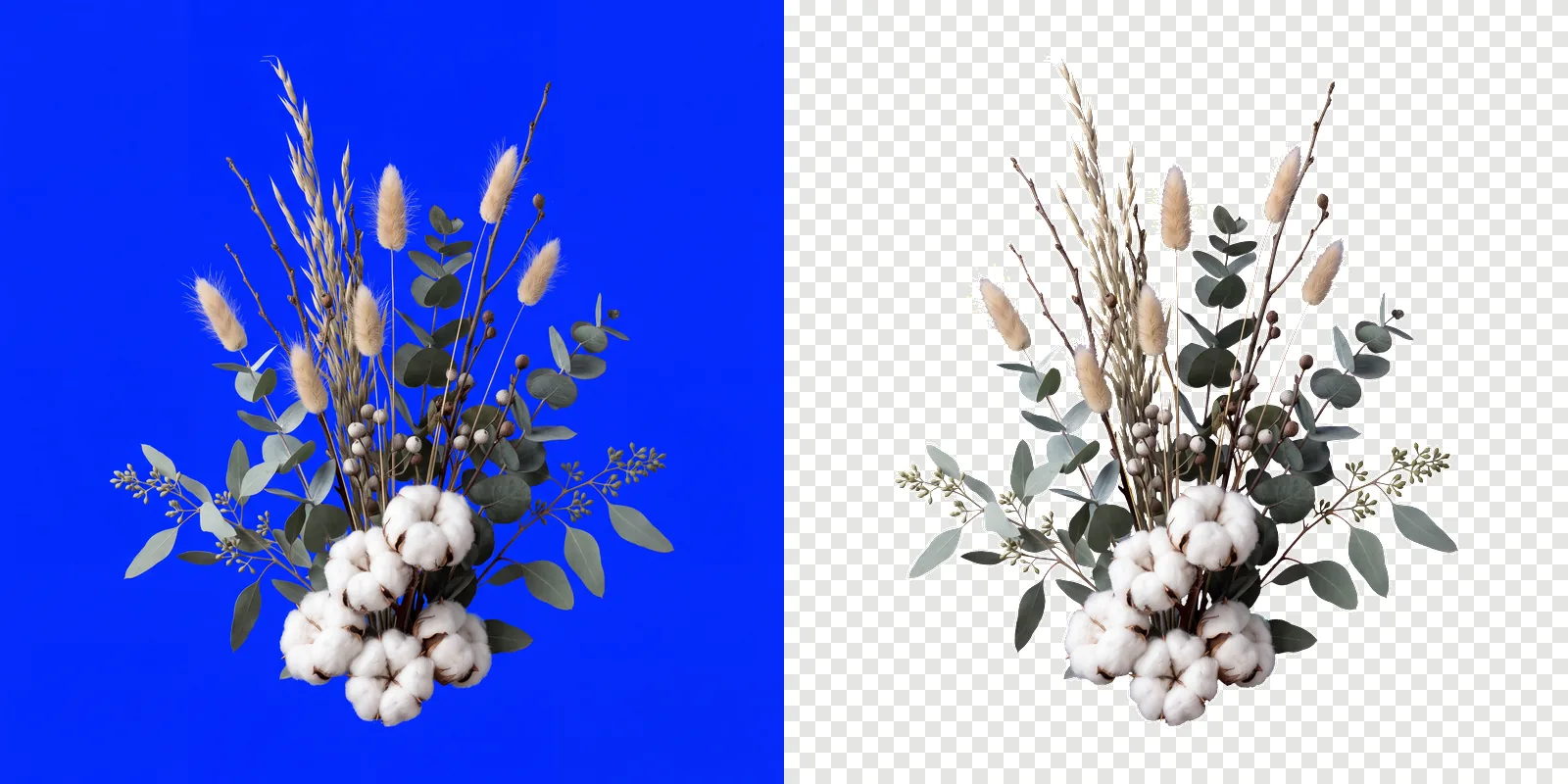
The render, and the cut ClipBrook makes from it. nordic christmas arrangement of cotton bolls, dried bunny tail grasses and eucalyptus, upright sparse arrangement with tall dried stems at the back and the cotton bolls low at the front, the cotton bolls are opaque soft white with clearly defined outlines, not wispy or fibrous at the edge, the whole design is one single connected piece and every leaf, berry and stem grows physically out of it, with the background around it completely empty and nothing at all drawn anywhere else in the frame, photorealistic, highly detailed, bright neutral daylight, isolated on a completely flat, uniform, solid pure blue (#0000FF) digital chroma-key background, everything in sharp focus with deep depth of field, no bokeh or background blur, evenly lit with soft neutral studio light, no cast shadow, no contact shadow, no ambient occlusion, no bounce light, the background stays uniformly bright inside every gap between leaves, petals and stems, no text. The pure blue background fills the image edge to edge like a flat digital chroma-key screen with no gradient, staying the same bright pure blue inside every gap; no reflection or tint of pure blue on the subject. Every leaf, petal and stem has a crisp, sharp, hard edge against the pure blue - no soft, blurry, feathered or glowing transitions, no depth-of-field blur, no haze or halo; inside every hole and gap between the leaves the pure blue is at full brightness right up to the edge of the leaf. Shaded parts of the subject keep their own natural colour (dark green, brown), never a pure blue or violet tint. The entire subject is centred and completely inside the frame with at least 10% empty background margin on every side, nothing cropped or touching the image edges. No frame, no border, no paper, no mockup, no vignette, no text, no watermark, botanically correct, no deformed or duplicated parts. No floating or detached fragments, no stray specks, dust or debris anywhere on the background; every element is physically attached to the arrangement.
frosted pine wreath
frosted pine wreath dusted with dry white frost, thick abundant ring with sprigs extending naturally outward past the outer edge, empty center with copy space, the frost is opaque crisp white crystals clinging to the surface with hard defined edges, not a translucent haze, no glitter particles, no mist, photorealistic, highly detailed, cool bright winter daylight, isolated on a completely flat, uniform, solid pure blue (#0000FF) digital chroma-key background, everything in sharp focus with deep depth of field, no bokeh or background blur, evenly lit with soft neutral studio light, no cast shadow, no contact shadow, no ambient occlusion, no bounce light, the background stays uniformly bright inside every gap between leaves, petals and stems, no text. The pure blue background fills the image edge to edge like a flat digital chroma-key screen with no gradient, staying the same bright pure blue inside every gap; no reflection or tint of pure blue on the subject. Every leaf, petal and stem has a crisp, sharp, hard edge against the pure blue - no soft, blurry, feathered or glowing transitions, no depth-of-field blur, no haze or halo; inside every hole and gap between the leaves the pure blue is at full brightness right up to the edge of the leaf. Shaded parts of the subject keep their own natural colour (dark green, brown), never a pure blue or violet tint. The entire subject is centred and completely inside the frame with at least 10% empty background margin on every side, nothing cropped or touching the image edges. No frame, no border, no paper, no mockup, no vignette, no text, no watermark, botanically correct, no deformed or duplicated parts. No floating or detached fragments, no stray specks, dust or debris anywhere on the background; every element is physically attached to the arrangement.
watercolor winter frame
watercolor winter frame of painted broad leaves and berries, square frame, airy and open with plenty of visible negative space, the leaves overlapping along one continuous painted band, empty center with copy space, the whole design is one single connected piece and every leaf, berry and stem grows physically out of it, with the background around it completely empty and nothing at all drawn anywhere else in the frame, watercolor painting, loose wet-on-wet washes inside the shapes, even flat light, isolated on a completely flat, uniform, solid pure blue (#0000FF) digital chroma-key background (the paper texture and washes belong to the subject only, the background itself is a flat digital colour fill), the outer silhouette has crisp defined edges where the paint meets the background with no bleeding, feathering or water blooms into the background, evenly lit, no cast shadow, no drop shadow, no ambient occlusion, the background stays uniformly bright inside every gap between petals and leaves, no text, no watermark. Painted watercolor style, but the background itself stays a flat digital colour fill with no paper texture. The pure blue background fills the image edge to edge like a flat digital chroma-key screen with no gradient, staying the same bright pure blue inside every gap; no reflection or tint of pure blue on the subject. Every leaf, petal and stem has a crisp, sharp, hard edge against the pure blue - no soft, blurry, feathered or glowing transitions, no depth-of-field blur, no haze or halo; inside every hole and gap between the leaves the pure blue is at full brightness right up to the edge of the leaf. Shaded parts of the subject keep their own natural colour (dark green, brown), never a pure blue or violet tint. The entire subject is centred and completely inside the frame with at least 10% empty background margin on every side, nothing cropped or touching the image edges. No frame, no border, no paper, no mockup, no vignette, no text, no watermark, botanically correct, no deformed or duplicated parts. No floating or detached fragments, no stray specks, dust or debris anywhere on the background; every element is physically attached to the arrangement.
minimalist winter branch line drawing
minimalist winter branch line drawing, one slender branch with a few small leaves rising vertically, solid pure black lines of uniform thin stroke weight, fully opaque with hard clean edges, no grey wash, no gradient, no shading and no sketchy double strokes, minimalist elegant line art with thin clean lines, isolated on a completely flat, uniform, solid pure blue (#0000FF) digital chroma-key background, everything in sharp focus with deep depth of field, no bokeh or background blur, evenly lit with soft neutral studio light, no cast shadow, no contact shadow, no ambient occlusion, no bounce light, the background stays uniformly bright inside every gap between leaves, petals and stems, no text. The pure blue background fills the image edge to edge like a flat digital chroma-key screen with no gradient, staying the same bright pure blue inside every gap; no reflection or tint of pure blue on the subject. Every leaf, petal and stem has a crisp, sharp, hard edge against the pure blue - no soft, blurry, feathered or glowing transitions, no depth-of-field blur, no haze or halo; inside every hole and gap between the leaves the pure blue is at full brightness right up to the edge of the leaf. Shaded parts of the subject keep their own natural colour (dark green, brown), never a pure blue or violet tint. The entire subject is centred and completely inside the frame with at least 10% empty background margin on every side, nothing cropped or touching the image edges. No frame, no border, no paper, no mockup, no vignette, no text, no watermark, botanically correct, no deformed or duplicated parts. No floating or detached fragments, no stray specks, dust or debris anywhere on the background; every element is physically attached to the arrangement.
When the badge says the key color is inside the subject
After each cut, ClipBrook counts the pixels deep inside the subject that sit at the background color. A few are harmless, and some subjects genuinely contain a little of the key. A lot of them means the render put your key color where it does not belong, a blue butterfly on a blue background being the obvious case, and no slider setting rescues that, because the cut cannot keep a color it is busy removing.
The fix is the same prompt sent again on the other key, which is a one-word edit. Depending on how much of the subject was lost, the badge reads Warning or Bad cut beside the finding, and the advisor names the fallback next to its first choice for this reason.
Your generator
The block works everywhere. Where it goes, whether the tool has a negative prompt, and which habits you have to switch off first are different in each one. Each page below has a copy-ready prompt.
- Midjourney · The /imagine box in Discord, or the prompt bar on midjourney.com.
- FLUX (ComfyUI) · The positive CLIP Text Encode node of your ComfyUI graph; the T5 branch takes the full sentences as written.
- Stable Diffusion (SDXL) · The positive prompt field in AUTOMATIC1111 or ComfyUI; the negative list goes in the negative prompt field.
- Gemini (Nano Banana) · The chat message itself; Gemini takes the whole prompt as plain conversation.
- DALL·E 3 (ChatGPT) · The ChatGPT message; ChatGPT rewrites the prompt before DALL·E sees it.
- Ideogram · The prompt field on ideogram.ai; the negative prompt sits under advanced settings (negative_prompt in the API).
- Leonardo.Ai · The prompt field; switch on the negative prompt toggle beneath it for the list.
Then cut them out
Download the finished renders at full size and drop the lot into ClipBrook. Your images stay on your computer. Nothing is uploaded. Each one comes back as a PNG with a transparent background.